- HOME
- Industries Served
- Automotive
Rubber Components for the Automotive Industry
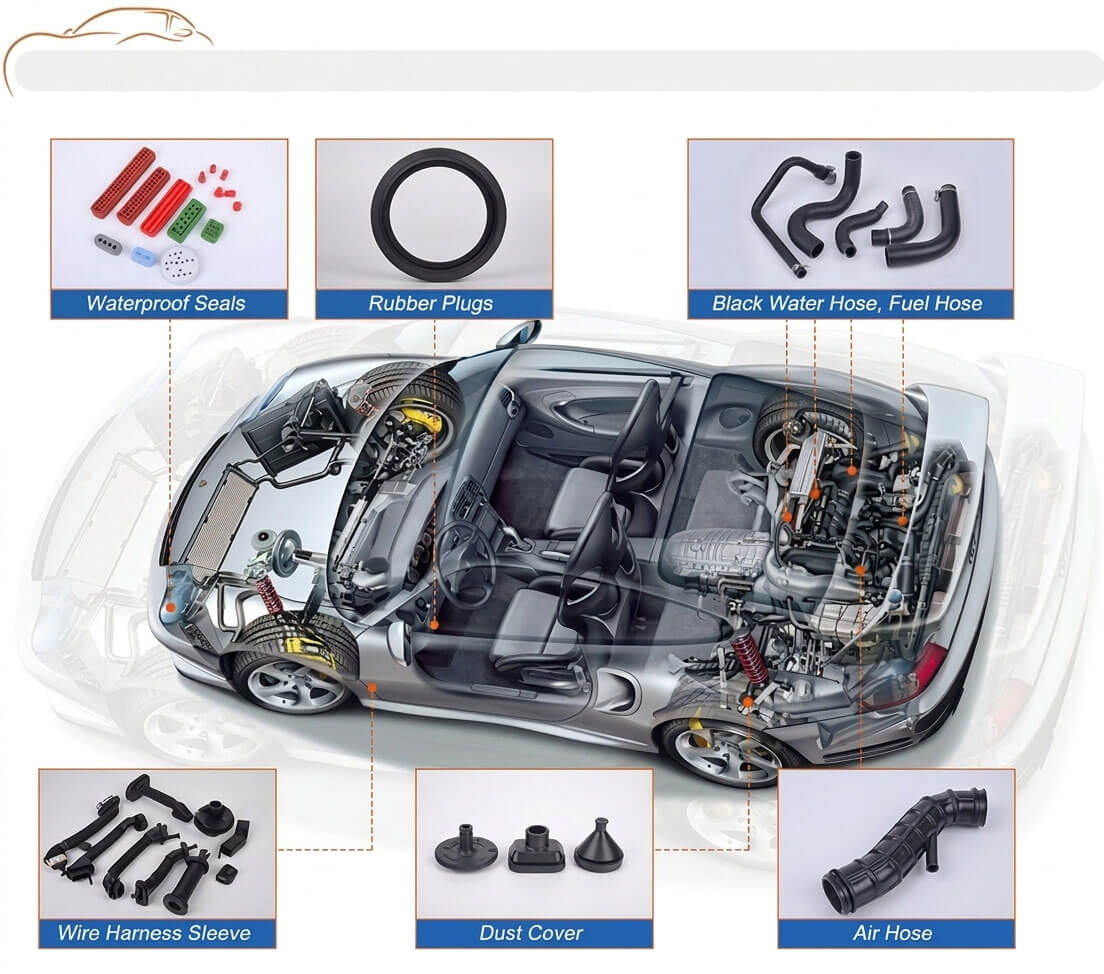
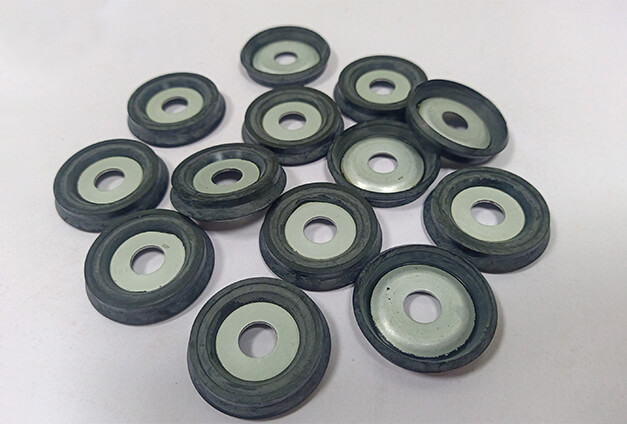
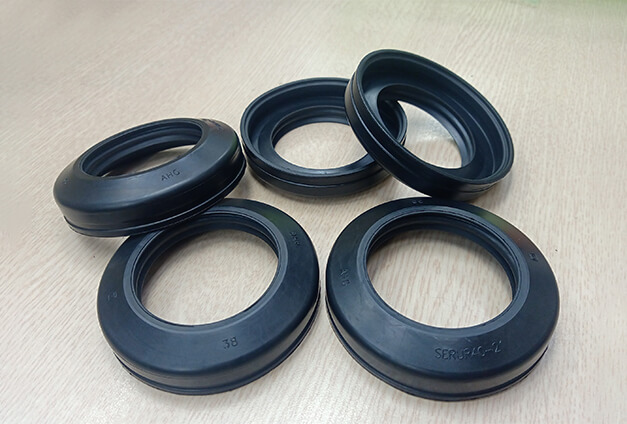
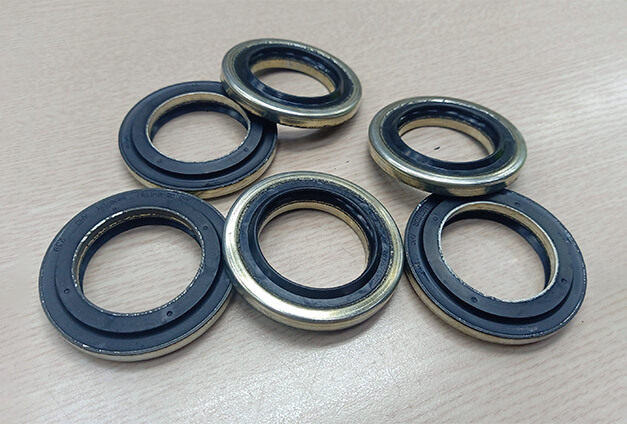
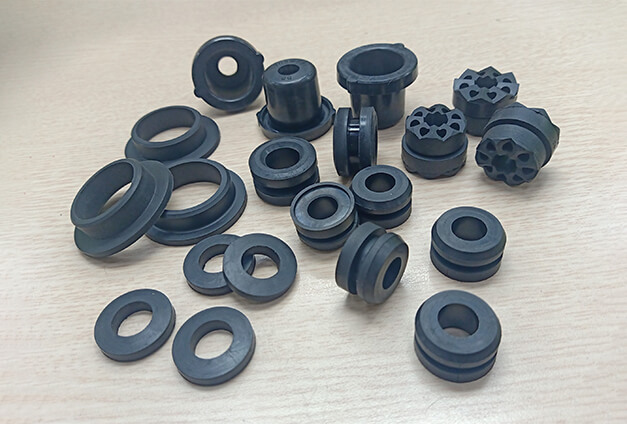
JHAO YANG RUBBER — OEM Supplier for Automotive Engineers
Rubber components are critical to vehicle performance, safety, and longevity. For automotive engineers and sourcing teams, selecting the right rubber solution means balancing material compatibility, dimensional precision, and compliance with industry standards — all while maintaining supply chain reliability.
JHAO YANG RUBBER has supplied custom rubber components to automotive OEMs and Tier 2/3 manufacturers across Asia and globally, with products certified to CE, NSF, and UL standards. Whether you are designing new assemblies or sourcing replacement components, our team works from your specifications to deliver the right material, geometry, and tolerance.
Common Automotive Engineering Challenges
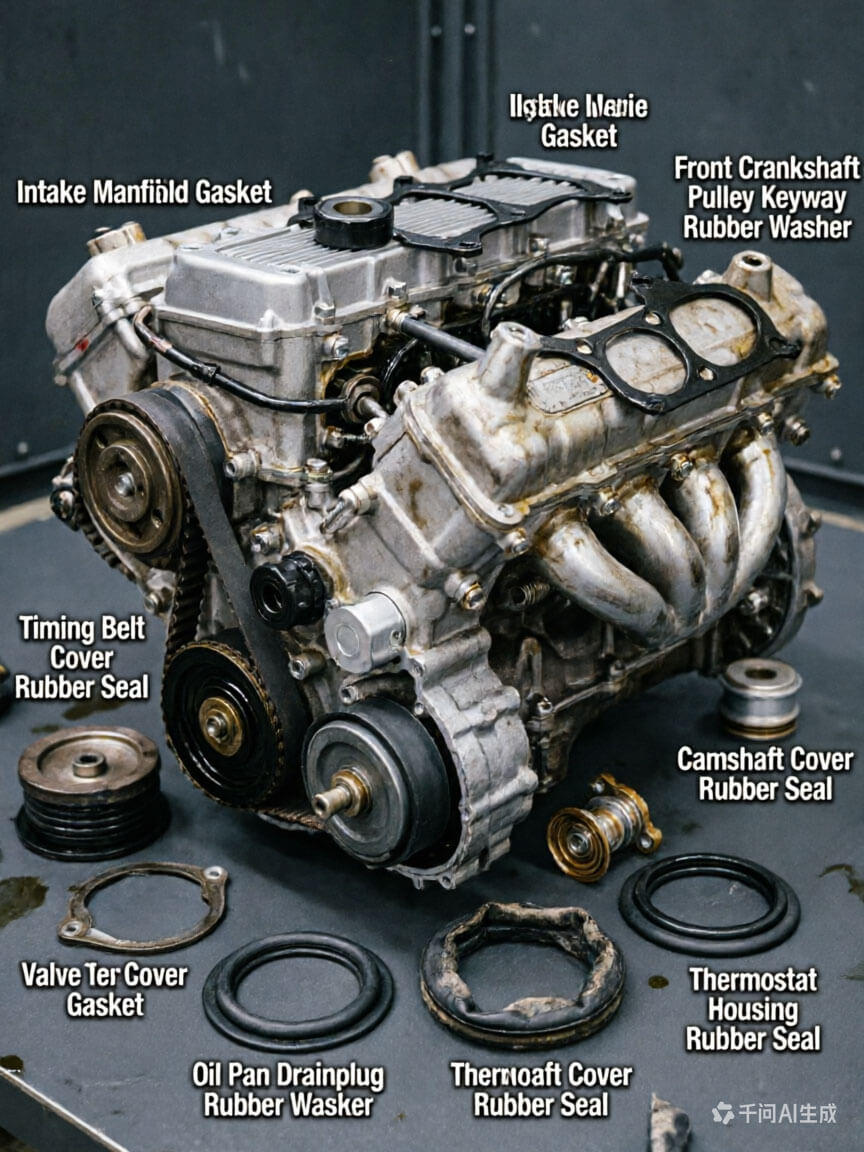
Engine & Powertrain Sealing
Engine environments expose rubber components to motor oil, coolant, and intermittent temperatures that can exceed 150°C. Standard rubber compounds degrade quickly under these conditions, leading to leaks and premature failure. Components in this application require oil-resistant materials with strong compression-set resistance to maintain sealing integrity over extended service life.
Typical parts: gaskets, O-rings, oil seals, hose connectors → View rubber gaskets & seals | View rubber O-rings
Brake & Transmission Systems
Brake and transmission assemblies demand rubber components that resist hydraulic fluids and brake fluid (DOT 3/4/5) without swelling or softening. Dimensional stability under pressure is non-negotiable — even minor deformation can compromise braking response.
Typical parts: rubber diaphragms, seals, O-rings, plugs → View rubber diaphragms | View rubber plugs
Vibration Damping & NVH Control
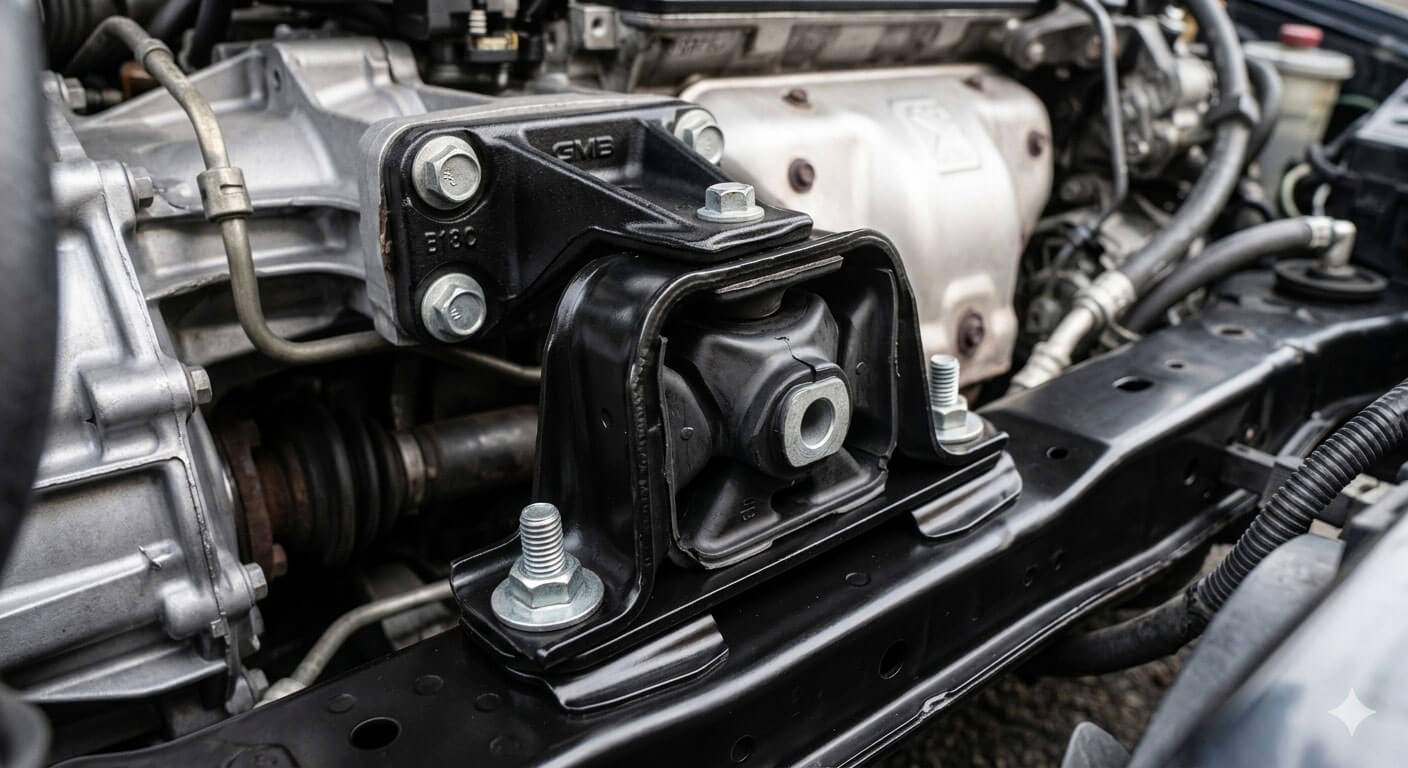
Noise, Vibration, and Harshness (NVH) performance is a key quality benchmark in modern vehicle design. Rubber mounts, dampers, and isolators are placed at critical junctions — engine cradles, suspension points, exhaust hangers — to absorb vibration energy and prevent it from transmitting to the chassis or cabin.
Typical parts: rubber mounts, dampers, isolators, bushings → View rubber mounts | View damper & cushion | View rubber isolators
Door, Window & Body Sealing
Weatherstripping and body seals must withstand UV radiation, ozone, rain, and extreme temperature cycling — from −40°C winter storage to summer heat soaking above 80°C inside a parked vehicle. Seals that harden or crack compromise both noise isolation and water ingress protection, leading to warranty claims.
Typical parts: rubber grommets, caps, bumpers, seals → View rubber grommets | View bumper & stopper | View cap & cover
Wiring Harness & Electrical Protection
Modern vehicles carry hundreds of meters of wiring. Grommets and boots protect harness pass-throughs from chafing against metal edges, and insulate against moisture ingress at body panel penetrations. These parts require consistent hardness and tear resistance, as well as UL-recognized materials where electrical safety compliance is specified.
Typical parts: rubber grommets, boots, caps → View rubber grommets | View boot & bushing
Rubber Components for Electric Vehicles (EVs)
Electric vehicles introduce engineering demands that do not exist in internal combustion engine (ICE) vehicles — and several of these directly affect rubber component selection. Using ICE-grade rubber compounds in EV applications is not simply suboptimal; in certain systems, it can create safety risks.
Battery Thermal Management Sealing
ICE cooling systems operate at 85–215°C and use petroleum-additive coolants that standard rubber compounds handle reliably. EV battery packs, by contrast, require tightly controlled temperatures between 20–40°C, and the coolant chemistry is fundamentally different.
EV thermal management fluids must maintain low electrical conductivity — most OEM specifications now converge around 100 µS/cm — to prevent battery thermal runaway in the event of a coolant leak. Rubber seals and gaskets in contact with this fluid must not leach ionic compounds into the coolant, as doing so raises conductivity and introduces fire risk. EPDM and VMQ (Silicone) are the preferred compounds for EV cooling circuit seals, specifically because they are chemically inert to glycol-water fluids and do not contaminate conductivity over service life.
Typical parts: gaskets, O-rings, hose seals for battery cold plates and cooling circuits → View rubber gaskets & seals | View rubber O-rings
Battery Pack Enclosure & IP Sealing
EV battery packs must achieve IP67 or IP68 ingress protection ratings — a requirement that does not exist for ICE powertrains. Enclosure seals must maintain integrity across repeated thermal cycling (the pack heats during discharge and cools during charging), resist electrolyte exposure in the event of cell damage, and perform reliably across a service life measured in years and hundreds of thousands of charge cycles.
Typical parts: compression gaskets, perimeter seals, plug seals for battery enclosures → View rubber gaskets & seals | View rubber plugs
High-Voltage Wiring & Connector Protection
ICE vehicles operate 12V systems. EVs run at 400V–800V. Rubber components protecting EV wiring harnesses, connector boots, and pass-throughs must provide high dielectric strength — not just basic abrasion protection. A grommet that would perform adequately in a 12V ICE harness may be entirely unsuitable at 800V. EPDM compounds with specified dielectric strength ratings are the standard recommendation for EV high-voltage protection applications.
Typical parts: rubber grommets, boots, caps for HV harness routing → View rubber grommets | View boot & bushing
NVH in Electric Vehicles vs. ICE: Why Rubber Requirements Differ
Noise, Vibration, and Harshness (NVH) is not a new challenge, but EVs have fundamentally changed what engineers need to control — and this directly affects how rubber damping components must be specified.
The Masking Effect Problem
In an ICE vehicle, engine combustion noise — low-frequency, broadband, and constant — acoustically masks many secondary vibration sources. Road noise, wind noise, and component resonances are present, but largely hidden behind the engine's acoustic signature.
Electric vehicles eliminate this masking effect entirely. At low speeds, EVs can be up to 20 dB quieter than equivalent ICE vehicles. The result: noise sources that were previously inaudible become clearly perceptible to occupants. Tire contact noise, wind buffeting, HVAC compressor hum, and even minor component resonances now require active management.
For rubber damping components, this means the tolerance for performance compromise is much smaller. A rubber mount that provides "adequate" NVH isolation in an ICE vehicle may be noticeably insufficient in an EV.
Frequency Shift: The Core Technical Difference
ICE engine mounts are tuned to absorb low-frequency vibration — typically the firing pulses of a combustion engine in the 20–200 Hz range. EV powertrains generate a different vibration profile. Electric motors produce electromagnetic force harmonics and inverter switching noise at significantly higher frequencies, often in the 500–10,000 Hz range. Road and tire noise, amplified by the heavier weight of EV battery packs, adds further broadband excitation.
Rubber mounts and isolators for EV applications must therefore be compounded and geometrically designed to absorb higher-frequency energy. A mount designed for an ICE engine — optimised for low-frequency damping — will not provide equivalent isolation in an EV powertrain, even if the geometry is identical.
Typical parts: rubber mounts, isolators, dampers for EV motor cradles, inverter mounting, suspension interfaces → View rubber mounts | View damper & cushion | View rubber isolators
Additional EV NVH Sources Requiring Rubber Solutions
| NVH Source | Characteristic | Rubber Solution |
|---|---|---|
| Electric motor whine | High-frequency (500–10,000 Hz), tonal | Tuned motor mounts with higher dynamic stiffness at target frequencies |
| Inverter switching noise | High-frequency electromagnetic vibration | Rubber isolation pads under inverter housing |
| Road / tire noise | Broadband, amplified by battery pack weight | Suspension bushings with broader frequency absorption range |
| Regenerative braking | Abrupt torque reversal, low-frequency jolt | Drivetrain rubber couplings with high torsional compliance |
| HVAC compressor (electric) | Mid-frequency, cyclic | Compressor mount isolators |
ICE vs. EV Rubber Specification — Quick Reference
| Requirement | ICE Vehicle | Electric Vehicle |
|---|---|---|
| Coolant seal compound | NBR / EPDM (standard glycol compatible) | EPDM / VMQ (low ionic extraction, conductivity-safe) |
| NVH mount tuning frequency | Low (20–200 Hz, combustion firing pulses) | High (500–10,000 Hz, motor harmonics + road noise) |
| HV wiring protection | Standard abrasion resistance | High dielectric strength specified |
| Battery enclosure sealing | Not applicable | IP67/68 rated, thermal-cycle stable |
| Thermal operating range | 85–215°C (engine bay) | 20–40°C (battery pack), −40°C to +150°C (motor bay) |
When submitting an RFQ for EV applications, please indicate the powertrain type, operating voltage, and fluid contact conditions so our engineering team can recommend the appropriate compound.
Selecting the Right Rubber Material for Automotive Applications
Material selection is one of the most common points of failure in automotive rubber sourcing. The wrong compound — even in the correct geometry — will degrade under the operating conditions it encounters.
| Application Environment | Recommended Material | Key Property |
|---|---|---|
| Engine oil, hydraulic fluid contact | NBR (Nitrile) / HNBR | Excellent oil & fuel resistance |
| High-heat under-hood / EV motor bay | VMQ (Silicone) | Stable from −60°C to +200°C |
| Outdoor / UV / ozone exposure (body seals) | EPDM | Outstanding weathering resistance |
| Aggressive chemical contact / EV high-voltage | FKM (Viton) | Broadest chemical resistance |
| General / EV NVH damping | NR (Natural Rubber) | Superior dynamic resilience |
| Flame-retardant / low-smoke requirement | CR (Neoprene) | Good flame resistance |
| EV coolant circuit sealing | EPDM / VMQ | Low ionic extraction, conductivity-safe |
JHAO YANG RUBBER produces components across all major rubber compounds. If your application requires a compound not listed here, our engineers will advise on the appropriate formulation based on your operating conditions and test requirements.
Compliance & OEM Qualification
Automotive supply chains require traceability and documented quality processes. Our facilities and products support the following:
- CE Certification — compliance with European safety and environmental directives
- UL Recognized Materials — for components in electrical applications
- NSF Certification — for fluid-contact components requiring potable water or food-grade compliance
- Custom OEM Documentation — material certifications, dimensional inspection reports, and packaging specifications available upon request
Frequently Asked Questions
Can you manufacture to automotive-specific material specifications (e.g., GM, Ford material specs)? Yes. We accept customer-supplied material specifications and compound requirements. Please provide the specification number or datasheet at the time of inquiry, and our engineering team will confirm compliance or propose an equivalent approved compound.
What is your typical lead time for custom automotive rubber components? For new tooling and first production, standard lead time is 3–5 weeks depending on part complexity. Repeat orders from existing tooling typically ship within 2–3 weeks. Rush scheduling is available — contact our team to discuss your timeline.
Do you offer PPAP documentation? We support customers with dimensional inspection reports, material certifications, and process documentation. Please indicate your documentation requirements when submitting your RFQ.
What order quantities do you support? We work with both small-batch prototype orders and high-volume production runs. OEM and Tier 2/3 supply programs are welcome.
What rubber compounds do you recommend for EV battery thermal management seals? For EV cooling circuit applications, we recommend EPDM or VMQ (Silicone) compounds. Both are chemically inert to glycol-water thermal management fluids and will not elevate coolant electrical conductivity — a critical requirement given that most EV OEM specifications require coolant conductivity below 100 µS/cm to prevent battery thermal runaway risk.
Work with JHAO YANG RUBBER
Our automotive customers rely on us because we combine material expertise, flexible manufacturing (compression, transfer, and injection molding), and responsive customer service — including the ability to support custom OEM part numbers, packaging, and documentation requirements.